Real-time control, designed for the unknown.
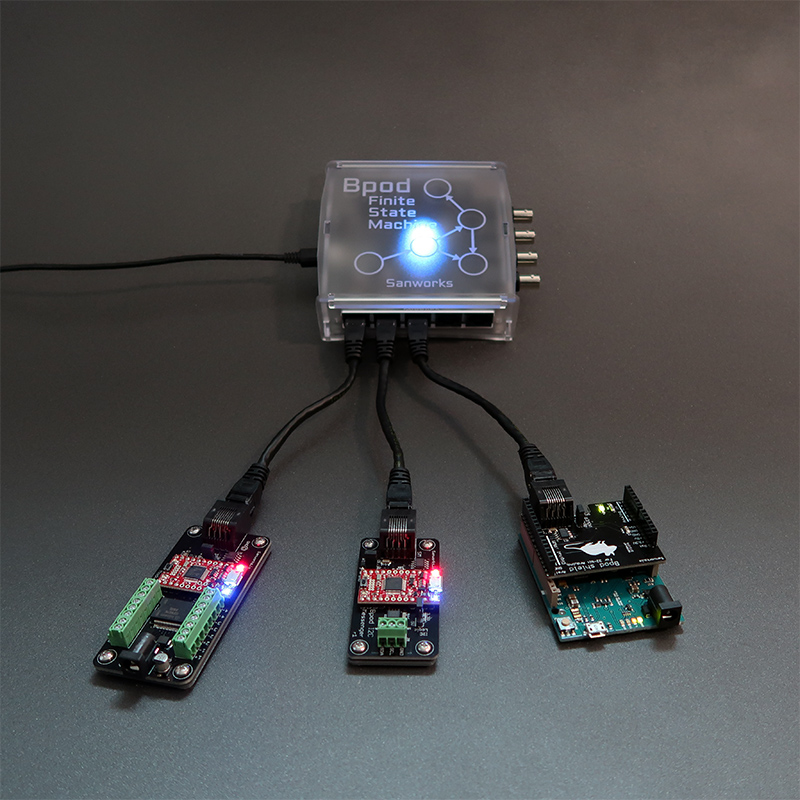
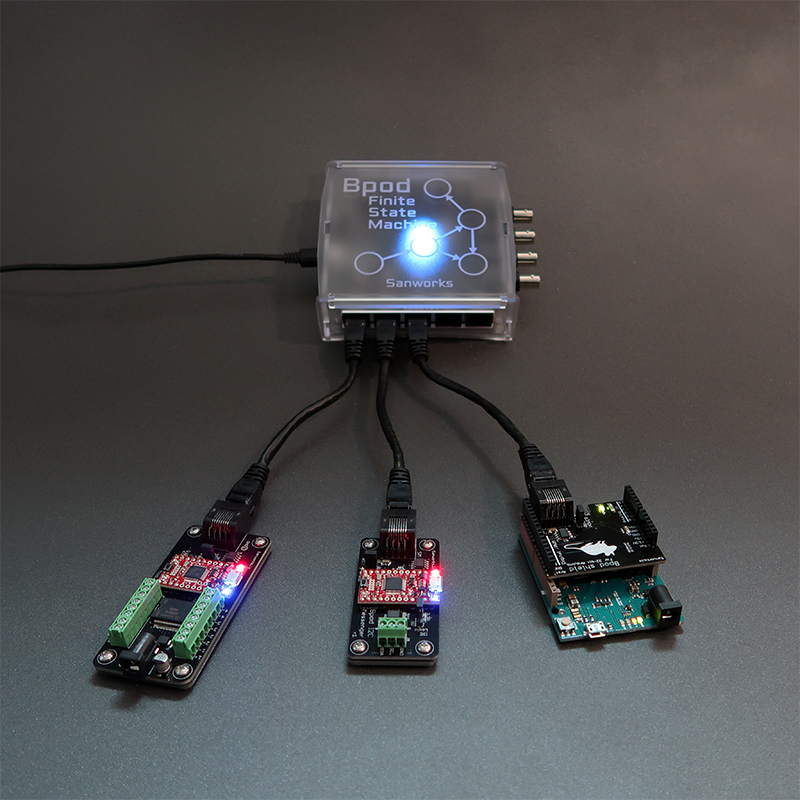
Your equipment orders and sponsorship this past year, have enabled us to develop an advanced, open-source behavior measurement system. Bpod Gen-II brings an ensemble of specialized behavior modules under control of a central finite state machine. In parallel, its modules can stream continuous data to each other to create closed sensory-motor feedback loops. The system-wide timing precision Bpod Gen-II provides is necessary for experimental rigor in systems neuroscience - to accurately align external events to records of the brain's internal signals.
The Bpod Gen-II hardware family consists of 12 Arduino-programmable devices which you can order pre-assembled or build yourself:
State Machine Controllers
- State Machine r1 is a real-time controller for up to 8 behavior ports (IR gate + solenoid valve + visible LED) and 3 modules.
- State Machine r2 has fewer ports, more modules, a more powerful valve driver and a >2x faster central processor. It also supplies power to compatible modules.
- Analog Ouptut (4ch) plays voltage waveforms and stimulation patterns.
- Analog Ouptut (8ch) is an 8-channel version of the analog output module.
- Analog Input (8ch) logs+streams voltage signals, returns threshold events.
- DDS (direct digital synthesizer) plays pure synth waveforms up to 100kHz.
- Rotary Encoder logs+streams rotary motion, and returns threshold events.
- Valve Driver (8x) drives an array of independent solenoid valves.
- I2C Messenger interfaces the state machine with an I2C bus.
- SNES Module interfaces a Super Nintendo controller, for psychophysics.
- Arduino Shield interfaces the state machine with 32-bit Arduino boards.
- Teensy Shield interfaces the state machine with Teensy 3.X boards.
This year we also released a useful companion tool for vision research: Frame2TTL, to produce a logic signal the instant an LCD display updates during stimulus presentation. We also added a software patch (in public beta), to use Bpod Gen-II hardware with BControl software.
The Bpod Gen-II family's low-cost, open architecture makes it easier follow unexpected leads in behavior science, and to scale up behavior projects for big data on a limited lab budget.