Brain cells are frustratingly small.
Your brain is a network of ~100 billion tiny information processors, each ~1/500th of a centimeter across. New imaging technologies allow us to peek at the processing inside this network for the first time, while it classifies incoming sense data and computes motor responses. In this video from Sur lab at MIT, neurons in the visual cortex were genetically engineered to manufacture a gene called GCAMP6, which becomes strongly fluorescent when the neuron sends an electrical message to its targets. The upper-right inset in the video shows stripes moving in different directions, presented to the eye as the neurons were imaged. Watch again and see how individual neurons are activated by different movement directions. The visual cortex passes this movement-direction enriched data to a wide array of other brain regions, which collectively decide what (if anything) to do about it.
In the video, the crisp imagery was captured from below the surface of the brain with a really cool imaging technology - 2-photon laser scanning fluorescence microscopy. In practice, microscopes at the bleeding technological edge have to be built from scratch using lenses and filters (and a lot of justifiably expensive ThorLabs parts). This feat requires a strong physics and optics background, which many newcomers to Neuroscience don't yet have. But Francesca Anselmi at BioBus does - and she's happy to share it.
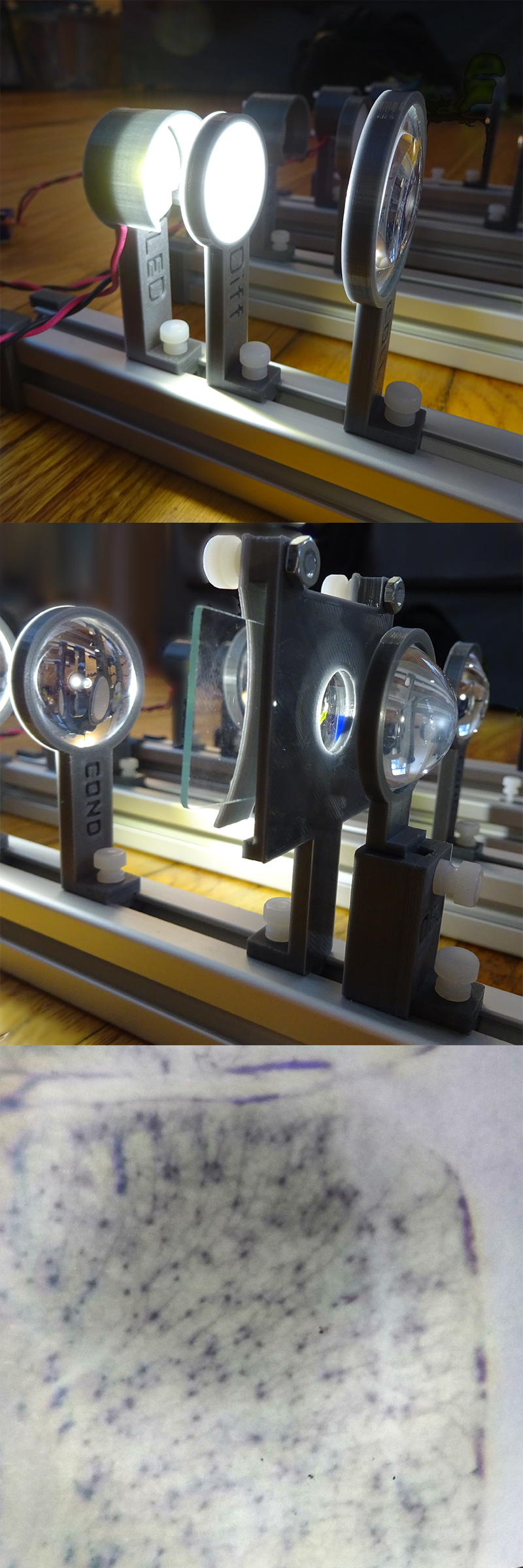
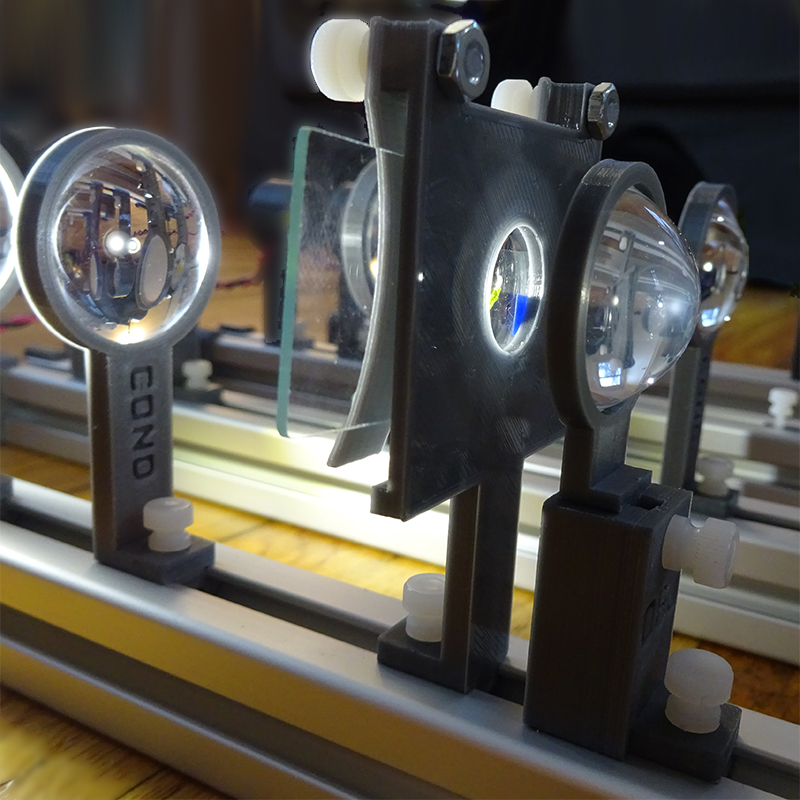
In January, we teamed together to help researchers (ages 12-99) learn how to build a powerful microscope from a pile of lenses. BioBus founder Ben Thaler enthusiastically agreed to provide support for R&D, and we set to work developing a prototype. First we designed a custom 3D-printed mounting system to fix lenses precisely to T-slot rails. We developed 3D-printed lens holders customized to press-fit inexpensive lenses, a screw-driven focusing mechanism for the objective lens, a sample holder and a powerful diffused illumination system with analog intensity control. At a final cost of $120 per microscope in parts (including lenses and illumination), we built 4 working copies. These prototypes now live on the BioBus, where they're being field tested with young minds.
In a departure from our policy of releasing Sanworks scientific instruments under GPL3.0, we agreed with our BioBus partners that this educational product's future should be shaped by scientists rather than toymakers. We jointly filed for a provisional patent on the design, and will release the files and documentation in the future under a more restrictive non-commercial license. With a light microscope in hand, our next step will be to produce a rich online media curriculum and assembly guide for the microscope. Further along, we intend to develop components for fluorescent imaging, dark field and phase contrast illumination, and other more advanced imaging techniques.